
 (416) 250-6856
 contact@drywalltoronto.ca
 Mon-Fri: 8AM - 4PM

The Hidden Cost of Mold — Why Skipping Moisture-Resistant Drywall Costs More
Nobody budgets for mold. It doesn’t show up on the original estimate, it doesn’t appear in the construction schedule and — for the first several months — it doesn’t show up on the wall either. That’s the problem. By the time mold becomes visible in a commercial space, the damage behind the surface is usually far worse than what you can see.
We’ve walked into commercial kitchens, clinic bathrooms and office utility rooms across the GTA where standard drywall was used to save a little money on the original build. What replaced it — remediation, reconstruction, lost business and, in some cases, legal exposure — cost many times more. It always does.
The hidden cost of mold is rarely visible on a spreadsheet until it’s too late. The math is simple – moisture-resistant drywall installation costs more upfront and less over the life of the building. Standard drywall costs less upfront and more — often far more — when the moisture problem it couldn’t handle finally surfaces. This blog explains why.
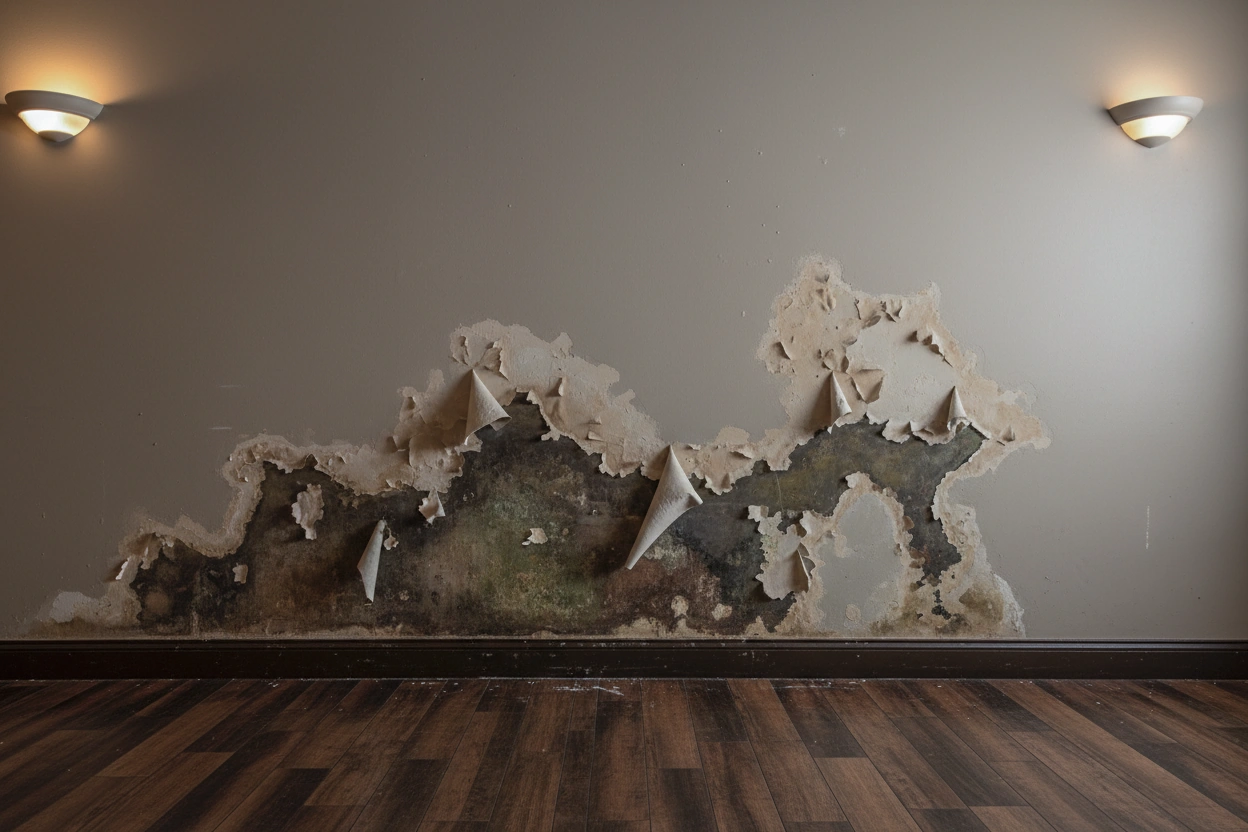
The Problem Starts Small (And Stays Hidden)
Mold doesn’t announce itself. It starts as a faint musty smell that people assume is poor ventilation. Then a faint discoloration appears near a baseboard or behind a shelf unit. By the time a property owner calls us, the colony has usually been growing for months — inside the wall cavity, behind the gypsum face, along the framing.
Standard drywall gives mold exactly what it needs – an organic paper facing that absorbs moisture and holds it. In a commercial kitchen running a full-day service or a clinic restroom used heavily throughout the day, that moisture exposure isn’t occasional. It’s constant. The paper facing never fully dries between cycles, and over time it becomes a food source.
The hidden part isn’t just the mold — it’s the timeline. A wall that looks fine at the six-month mark can have significant internal deterioration by year two. By the time the problem is obvious, you’re not patching a surface. You’re replacing an entire wall assembly.
That delay is why so many property owners connect the failure to bad luck rather than the original spec decision. It wasn’t bad luck. It was a predictable outcome of using the wrong material in the wrong place.
What Mold Actually Costs a Commercial Property Owner
Most property owners think about mold in terms of cleanup. The real cost is broader — and by the time all three categories surface, the original drywall upgrade that would have prevented it looks like the cheapest decision that was never made. Here’s what the full picture looks like. The costs of a mold event break into three categories — and most property owners only think about the first one until they’re dealing with all three simultaneously.
Remediation – The Bill Nobody Plans For
Mold remediation in a commercial building is not a weekend DIY job. Ontario has clear guidelines around commercial mold remediation and certified contractors are required for anything beyond surface-level contamination. Once the wall is opened, the scope almost always expands.
A full remediation typically includes containment, air scrubbing, demolition of all affected materials, antifungal treatment of the underlying framing, air quality testing and clearance certification. None of that is cheap — and none of it includes rebuilding the wall afterward. That’s a separate line item.
Compare that to the cost of upgrading to moisture-resistant drywall on the original build: a relatively small increase per square foot that, on most commercial jobs, adds a modest amount to the total drywall scope. The gap between the upgrade cost and the remediation cost is not close. It never is.
Business Interruption and Lost Revenue
Remediation requires the affected space to be vacated — and in a commercial setting, that means shutting down operations. A restaurant can’t serve food in a kitchen under active remediation. A clinic can’t see patients in rooms that are under containment. A retail space can’t trade when half the floor is sectioned off.
The business interruption cost depends on the operation, but the pattern is consistent – days or weeks of lost revenue, often with no guarantee of a fixed end date. If air quality testing fails clearance, the timeline extends. We’ve seen jobs quoted as a few days turn into weeks because the contamination had spread further than the initial assessment showed.
Insurance may cover some of the loss, depending on the policy. It rarely covers all of it — and the premium impact from making a claim is its own long-term cost that doesn’t show up in the immediate remediation bill.
Liability and Legal Exposure
This is the cost most property owners don’t consider until it’s directly in front of them. If tenants, employees or customers develop health issues linked to mold exposure — and the original construction record shows standard drywall was used in a zone where moisture-resistant board was mandated or reasonably required — that’s a liability problem with real legal and financial consequences.
Common exposure scenarios in commercial mold situations include:
- Tenant claims for health impacts or business property damage
- Commercial lease disputes over habitability and fitness for use
- Building code violation penalties if mandated materials weren’t specified
- Disclosure obligations when selling or refinancing the property
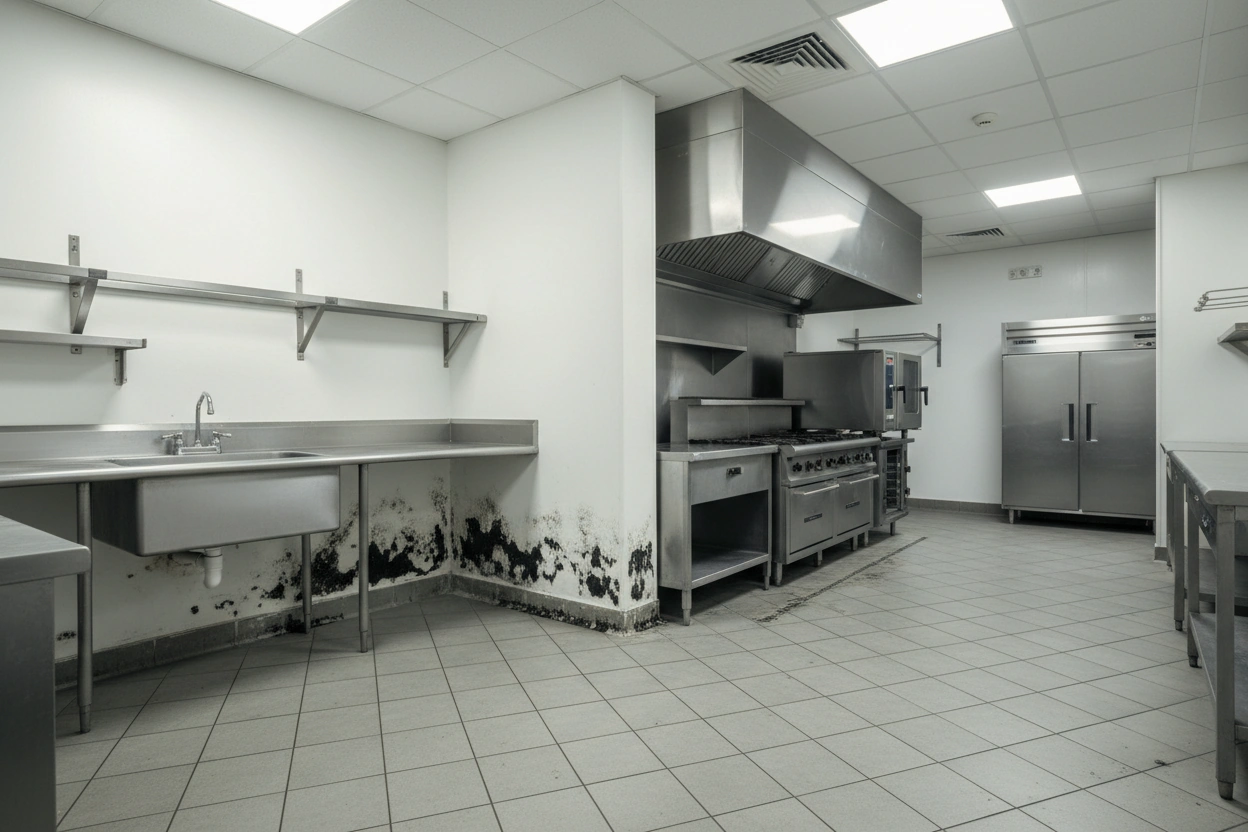
Why Standard Drywall Fails in Commercial Spaces
Bedrooms, living rooms and dry office environments — standard drywall installation was designed for these interior residential applications. It performs well in those settings. The paper facing bonds cleanly to the gypsum core, takes paint easily and holds up for decades under normal indoor conditions.
Commercial environments are not normal indoor conditions. The factors that accelerate failure in commercial settings:
- Higher occupancy loads — more people generating more sustained humidity
- Longer daily operating hours — less recovery time for walls to dry between wet cycles
- Chemical cleaning — commercial sanitizers penetrate paint and degrade paper facing over time
- Mechanical ventilation gaps — poorly balanced airflow creates persistent humidity pockets in corners and cavities
- Temperature differentials — server rooms, walk-in cooler adjacencies and loading areas all create condensation cycles
In most commercial spaces, two or three of these factors apply at the same time. That’s not a theoretical risk — it’s the operating reality of a functioning business. Moisture-resistant board handles this not by being waterproof but by being significantly more tolerant of these conditions. It gives the wall assembly a realistic chance of lasting the full building lifecycle without intervention.
The Real Price Difference Between Standard and Moisture-Resistant Drywall
The upgrade from standard to moisture-resistant drywall is a modest line item on any commercial project. On a typical commercial bathroom, kitchen or utility room, the difference in material and labour cost between standard board and a quality moisture-resistant option is small relative to the total project scope.
That one-time cost eliminates a recurring risk. The remediation, reconstruction and business interruption costs described above don’t happen once and go away — they’re a liability that persists as long as the wrong material is in the wall. Most experienced project managers who understand this relationship upgrade the spec without hesitation.
There’s also a compounding benefit worth noting: moisture-resistant board doesn’t just resist mold. It resists the softening, sagging and surface deterioration that drives repainting and patching costs in standard drywall under commercial conditions. The maintenance savings over five or ten years often justify the upgrade independently, separate from the mold risk entirely.
The ones who push back on the upgrade are usually optimizing for the lowest line item on a single bid — not for the total cost of ownership over the life of the building. Those are different calculations, and they lead to very different outcomes.
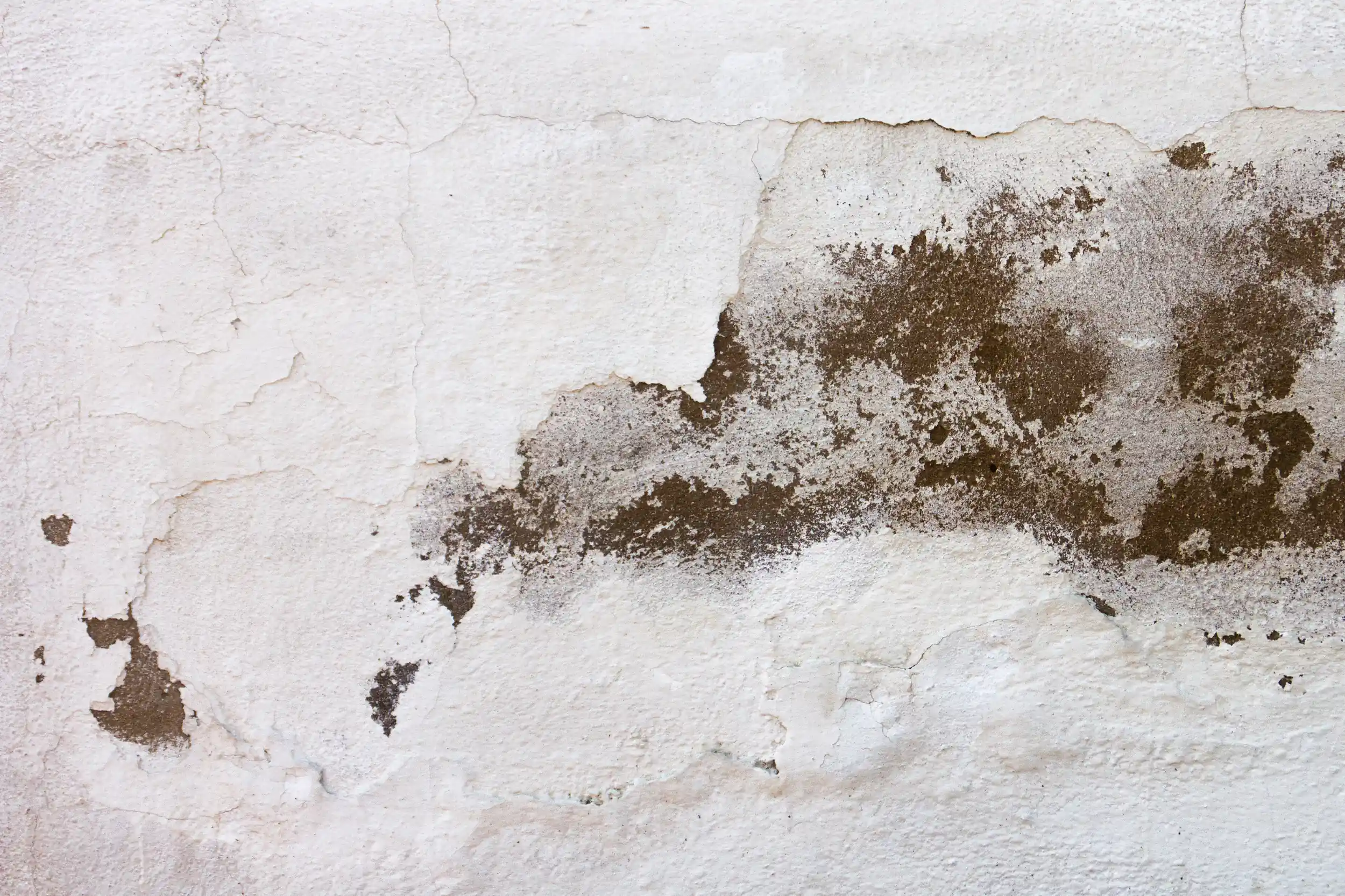
What Mold Does to a Commercial Building’s Value
Mold history follows a building. In Ontario, significant mold remediation events require disclosure in commercial real estate transactions. Buyers and lenders treat mold history as a material defect — because it is. It signals that the building has moisture management problems, and those problems may not be fully resolved even after a professional remediation.
The valuation and transaction impact is real and consistent:
- Reduced appraised value — buyers discount for mold history regardless of remediation documentation
- Extended time on market — commercial buyers conduct thorough environmental due diligence and mold flags slow that process significantly
- Additional lender requirements — some financing arrangements require third-party environmental certification before approval when mold history is present
A mold event that cost a fraction of the building’s value to remediate can trigger a valuation impact that far exceeds the original remediation cost. That’s a steep price for a series of material decisions that saved a small amount on original construction.
Buildings with recurring mold events — which happens when the root cause isn’t addressed, only the symptom — develop a reputation in the property management community. That reputation is difficult to reverse and affects tenant quality, lease rates and ultimately the long-term return on the asset.
Industries That Pay the Highest Price for Getting This Wrong
Mold is a problem in any commercial building, but some industries carry a disproportionate risk — because of the environment they operate in, the regulatory oversight they’re subject to or the direct connection between wall condition and their ability to operate at all.
Restaurants and Food Service
Toronto Public Health inspects restaurants on a regular cycle, and wall surface condition is part of that inspection. A wall that shows mold, moisture deterioration or surface damage in a food preparation area is a direct health code violation — not a warning, a violation.
The consequences are immediate:
- Closure order until the issue is fully resolved and re-inspection passed
- Re-inspection fees and a formal reinstatement process
- Public posting of the violation on the City of Toronto DineSafe database
- Reputational damage that persists online long after the violation is cleared
We’ve worked on restaurant remediation and rebuild jobs where the operator was closed for weeks and lost a significant portion of a season’s revenue. The upgrade that would have prevented it cost a fraction of that. It’s a painful comparison to make after the fact.
Commercial kitchen walls also need to be cleanable, not just moisture-tolerant. In most restaurant applications, we recommend moisture-resistant drywall as the substrate with FRP panels over the top in wet and high-splash zones. That combination delivers both structural moisture tolerance and the smooth, cleanable surface that health codes require.
Medical Clinics and Healthcare Facilities
Mold in a medical facility is a patient safety issue first and a property problem second. Immunocompromised patients face genuine health risks from mold spore exposure that healthy adults tolerate without symptoms. Regulatory bodies know this — which is why healthcare facility standards in Ontario are significantly more stringent than standard commercial building code.
The risk profile for healthcare operators who get the wall spec wrong goes beyond property damage:
- Accreditation review and potential suspension if mold is found during a facility inspection
- Patient complaint investigations linked to air quality concerns
- Reputational damage in a sector where patient trust is the foundational asset
- Regulatory compliance costs that dwarf the original material upgrade
We specify moisture and mold-resistant board with antimicrobial additives as a baseline for all clinical spaces — exam rooms, procedure areas, sterilization room adjacencies and any wall near a plumbing fixture. It’s not an optional upgrade on healthcare jobs we take on. The risk of getting it wrong is simply too high.
Property Managers and Multi-Tenant Buildings
Multi-tenant commercial buildings carry a compounding risk: one moisture problem in one unit can spread to adjacent units through shared wall assemblies, ceiling spaces and HVAC systems. A mold event in a ground-floor tenant space can migrate into the floor above. A wet utility room can affect the unit beside it before anyone notices.
Property managers face a dual exposure: their own remediation and reconstruction costs, plus tenant claims for business interruption, property damage and health impacts. Lease agreements typically don’t insulate building owners from these claims when the root cause is a construction or maintenance deficiency.
The practical recommendation: require moisture-resistant board in all wet zones, all below-grade spaces and all mechanical rooms as a non-negotiable spec item in your standard construction requirements. Enforce it during inspections. A change order to upgrade materials mid-project costs more than specifying correctly from the start — and far less than managing the fallout after a mold event.
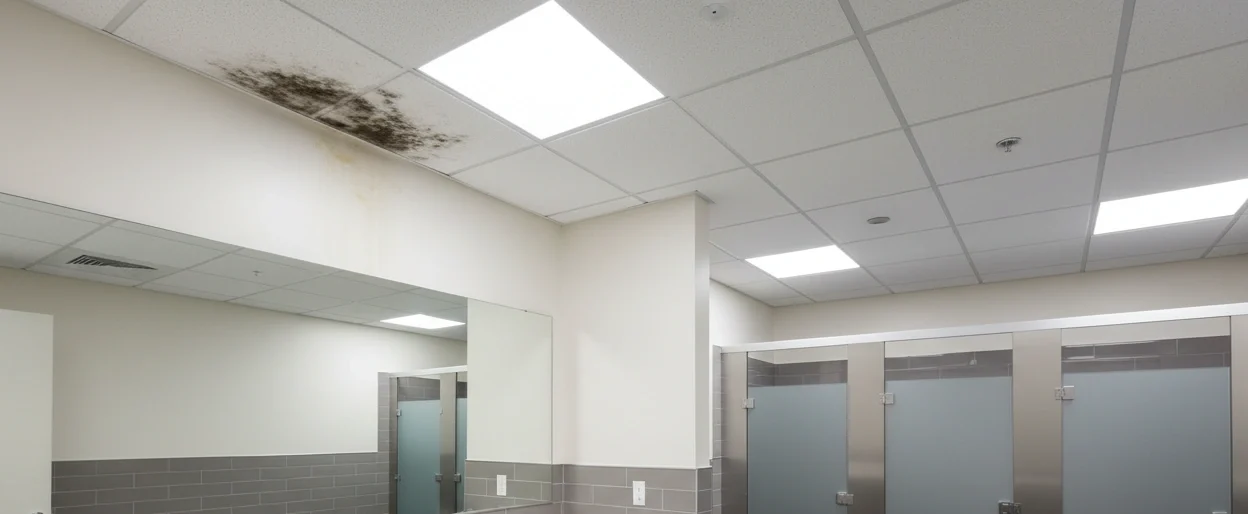
How to Spec Moisture-Resistant Drywall Before It Becomes a Crisis
The right time to get the spec right is before construction starts. But we also get called in mid-renovation and post-completion when a property owner realizes standard board was used in the wrong zones. Here’s how to approach each stage.
Before construction — work through this checklist with your drywall contractor:
- Identify every space within close proximity of a plumbing fixture
- Flag all below-grade finished spaces
- Mark mechanical and utility rooms on the plan
- Note any space that will be cleaned with commercial-grade sanitizers regularly
- Check adjacency to wet commercial operations — moisture migrates through wall assemblies
Mid-renovation — if standard board has already been installed in questionable zones, the cost of upgrading before the wall is closed is a fraction of the cost of addressing a mold problem after. Pull it and replace it. Yes, it’s frustrating. It’s also the right call.
Post-completion — if you’re inheriting a space and you’re not sure what’s in the walls, look for early warning signs: musty odors that don’t resolve with ventilation, surface discoloration near floor level or around fixtures, soft spots in the wall, paint that bubbles or peels without an obvious cause. Any of those warrant investigation before they become a remediation project.
The governing principle is straightforward: moisture-resistant drywall is a preventive measure, not a premium upgrade. It belongs in the same category as proper waterproofing, adequate ventilation and correct flashing details — basic elements of a building that’s built to last.
Express Drywall Services – We Get the Spec Right the First Time
Over 20 years of commercial drywall work across the GTA, we’ve seen what happens when the spec is right and what happens when it isn’t. We’ve done the remediation rebuilds. We’ve replaced assemblies that were a couple of years old because the wrong board was used in the wrong place. We’d rather not — and we’d rather you didn’t have to go through it either.
On every commercial project we take on — whether it’s a restaurant buildout in Mississauga, a clinic renovation in North York or a multi-tenant building upgrade in Vaughan — our process includes:
- A full site walk to identify every moisture-risk zone before we quote
- A clear specification that distinguishes between standard, moisture-resistant and FRP zones
- Transparent pricing on the upgrade so there are no surprises mid-project
- Installation practices matched to the material spec — correct fastener schedules, fiberglass tape on paperless board, sealed penetrations at every edge
We warranty all our work. If something we installed fails for reasons within our control, we come back and fix it. That warranty means we have direct skin in the game on every spec decision we make — which is why we don’t cut corners on material selection.
Free quotes are available within 48 hours. If you’re planning a commercial build or renovation anywhere in the GTA — Toronto, Etobicoke, Markham, Richmond Hill, Vaughan or beyond — reach out to Express Drywall Services and let’s look at your project before the walls go up. That’s when it’s easy. After is when it gets expensive.