 (416) 250-6856
 Mon-Fri: 8AM - 4PM

Type X Drywall in Commercial Buildings – What Ontario’s Building Code Actually Requires
Fire-resistant drywall comes up on almost every commercial project we work on — and yet it’s one of the most misunderstood materials in the trades. General contractors know they need it. Property managers know the inspector will ask about it. But the specifics — which assemblies, which locations, which ratings — tend to get sorted out late in the process, sometimes after drywall is already up.
This post lays out what the Ontario Building Code (OBC) actually requires for fire-rated assemblies in commercial construction, where Type X drywall fits into that picture and what happens when it’s not done right.
What Is Type X Drywall and How Does It Work?
Standard drywall — the 1/2″ board that goes on most interior walls — is not rated for fire resistance. It will slow flame spread for a short time, but it’s not engineered to hold up under sustained heat. Type X drywall is.
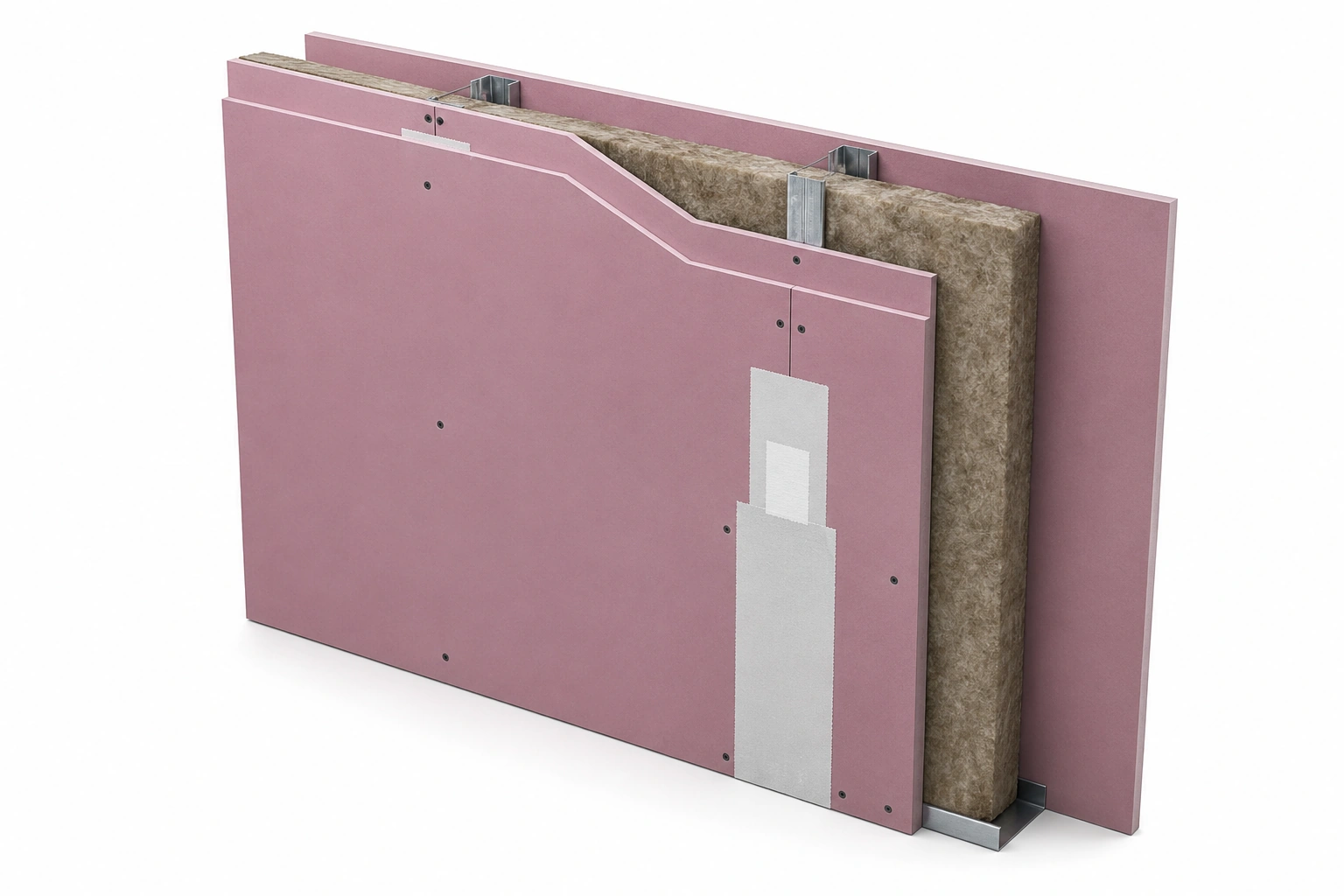
Type X is a 5/8″ gypsum board with glass fibre reinforcement added to the core. The fibres hold the board together as it calcines under heat, which slows the rate at which it loses structural integrity. This is what gives a properly assembled wall or ceiling its fire-resistance rating — not the board alone, but the board as part of a tested system: studs, fastener pattern, board thickness, number of layers and any additional materials like insulation or resilient channel.
One important distinction: the rating belongs to the assembly, not the product. Using Type X board in a non-compliant assembly does not give you a 1-hour wall. The assembly has to match a tested system — typically referenced by UL design number or NRC test data — and the installation has to follow that spec exactly.
Type C is a step up from Type X. It has additional vermiculite or shrinkage-compensating additives that improve performance under rapid heat exposure. Some assemblies specifically call for Type C, particularly in high-rise or healthcare applications. If the spec says Type C, Type X is not a substitution.
Where the Ontario Building Code Requires Fire-Rated Assemblies
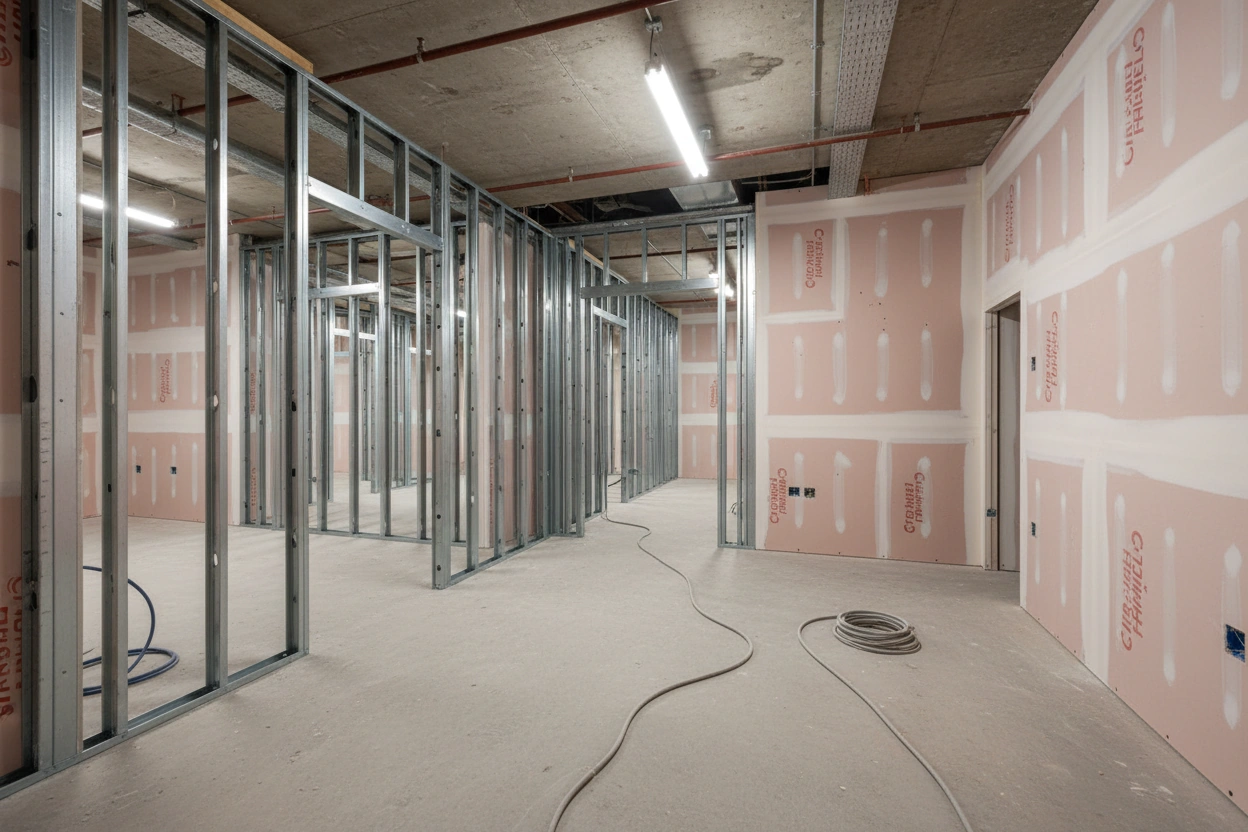
The OBC doesn’t leave much to interpretation on this. Fire separation requirements are set out in Division B, Part 3, and they apply based on occupancy classification, building height and the relationship between different occupancies or spaces within the same building.
The locations that come up most often in commercial work:
- Between different occupancy types — an office suite sharing a wall with a retail unit, or a restaurant sharing a floor/ceiling assembly with residential above
- Stairwell and exit enclosures — all exits in a building required to be of encumbered construction must be separated from the rest of the floor area with a fire-rated assembly
- Elevator and mechanical shafts — shaft wall assemblies around elevators and mechanical chases require fire separation per OBC 3.5
- Storage rooms, electrical rooms and service spaces — particularly in buildings over a certain occupancy load
- Party walls in multi-residential — between dwelling units, and between dwelling units and corridors
- Garages attached to other occupancies — require fire separation from the main building, typically at minimum 1-hour
The specific rating — 45 minutes, 1 hour, 2 hours — depends on the occupancy classification and building construction type. A 6-storey office building in Ontario is not held to the same standard as a 2-storey retail strip, and the code reflects that.
1-Hour vs. 2-Hour Rated Assemblies – What’s the Difference?
The rating is straightforward in concept: a 1-hour assembly must resist fire for a minimum of 60 minutes under standard test conditions before structural failure or flame penetration. A 2-hour assembly must hold for 120 minutes. The difference between those two numbers is not just time — it’s a fundamentally different assembly spec, different material quantities and different installation requirements. Understanding which rating applies to which location on your project is the first thing to confirm before a single sheet is ordered.
1-Hour Assembly
The most common configuration: 3-5/8″ or 6″ steel studs at 16″ o.c., single layer of 5/8″ Type X on each side, joints staggered and screwed to the OBC fastener schedule. This covers most demising walls, corridor separations and occupancy boundaries in standard office and retail construction.
2-Hour Assembly
Same stud configuration, but with a double layer of 5/8″ Type X on one or both sides — sometimes with Type C specified on the exposed face. The second layer is not just stacked on. It has to be offset from the first with joints not lining up, and fastened through both layers into the framing. Get the fastener schedule wrong and the assembly doesn’t perform as tested. That’s not a technicality; it’s what the inspector is looking at.
Acoustic assemblies sometimes complicate this further. Resilient channel between the stud and the board can affect fire performance depending on how it’s installed. Some tested assemblies incorporate resilient channel; others don’t. You can’t add it to a fire-rated assembly spec unless it’s part of the tested system.
Common Commercial Applications: Offices, Healthcare, Multi-Residential
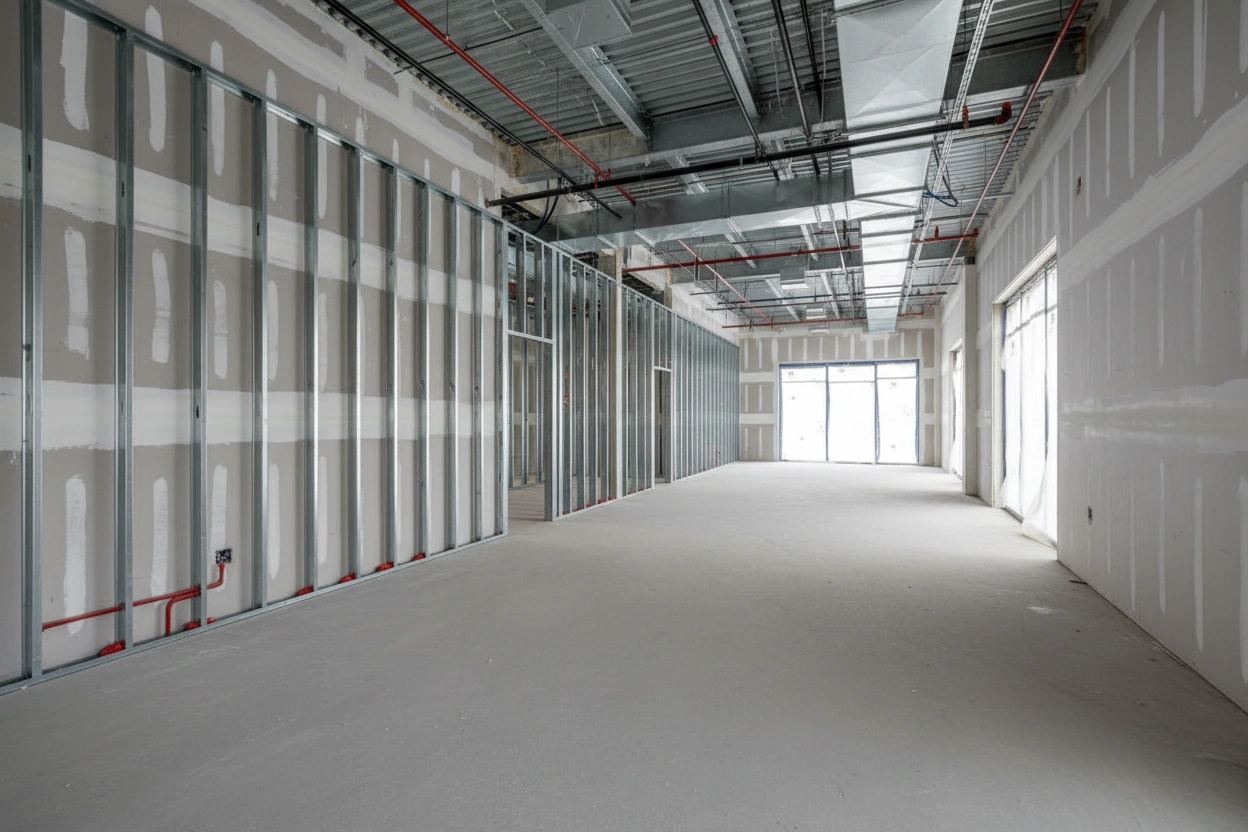
These three building types generate the majority of fire-rated drywall work across the GTA. The code requirements differ by occupancy class, but the practical execution — proper assembly spec, correct board, right fastener schedule — is consistent across all of them. What changes is the specific rating, the locations that trigger it and sometimes the drywall board type.
Office Buildings
Office buildings in Ontario typically require fire separation between tenant suites and between the tenant floor and vertical shafts. In open-plan offices, the separation is often at the demising wall level. In buildings with mixed use — office above retail, for example — the floor/ceiling assembly between occupancies carries a fire rating, usually 1-hour minimum. Tenant improvement projects are a common trigger: when a new tenant reconfigures a floor, the demising walls often need to be re-assessed and brought up to current code, which may mean rebuilding assemblies that were compliant under an older version of the OBC.
Healthcare Facilities
Clinics, medical offices and long-term care facilities are classified under Group B occupancy in the OBC and carry stricter requirements. Corridor walls often require 45-minute or 1-hour separation. Rooms with specific functions — storage of flammables, mechanical spaces, electrical rooms — may require 2-hour separation. Type C board is frequently specified here because of the occupant load and evacuation constraints. We’ve completed corridor separation work in medical office buildings across North York and Mississauga where the spec called for Type C on one face and Type X on the other. That’s an assembly detail that needs to be confirmed before ordering materials, not figured out on site.
Multi-Residential Buildings
Condos, apartment buildings and purpose-built rentals are where we see the most fire separation work in the GTA right now. Between suites, between suites and corridors, between parking levels and residential floors. The OBC is detailed on party wall requirements, and municipalities like Toronto and Mississauga have inspectors who know exactly what to look for. Purpose-built rental construction has been active across the 416 and 905 for the past several years, and virtually every project involves fire-rated assemblies at multiple locations throughout the building.
What Happens If Fire Separation Is Done Wrong?
This is where it gets real. A fire separation that doesn’t meet code isn’t just a deficiency on an inspection report — it’s a liability that follows the building.
Practically speaking, the consequences come in stages:
Failed inspection forces a stop-work order and remediation. If the drywall is already finished and painted, remediation means tearing out and redoing. On a commercial build, that’s a significant cost and schedule impact — sometimes weeks.
Concealed non-compliance is worse. If a building passes inspection with a non-compliant assembly — because someone substituted materials, skipped fire caulking at penetrations or ran the wrong fastener pattern — and a fire event occurs, the liability exposure for the GC, the drywall sub and the building owner is substantial.
Fire caulking at penetrations is one of the most commonly missed items. Any penetration through a fire-rated assembly — electrical conduit, plumbing, HVAC ducts — must be sealed with listed fire-stop material. The drywall board alone does not maintain the rating if there are unsealed holes through it. This is a code requirement, not a best practice.
Working With a Qualified Commercial Drywall Contractor in the GTA
Fire-rated assemblies are not the place to wing it. The assembly spec needs to be confirmed before material is ordered, the installation has to follow the tested system and penetrations need to be accounted for before the board goes up — not after.
This is one area where experience on the tools matters more than it might seem. Reading an assembly spec correctly, knowing which UL design number applies to the project conditions, understanding how resilient channel interacts with fire performance, recognising when a penetration location is going to cause a problem — these are things you learn by doing fire-rated work on real projects over time, not by reading the code once.
Express Drywall Services has been handling fire-rated commercial scopes across the GTA for more than 20 years. We work from the assembly spec, not assumptions, and we coordinate penetration sealing as part of the drywall scope rather than leaving it to whoever gets to it last. Our work covers Type X and Type C installations, shaft wall assemblies, corridor separations, floor/ceiling assemblies and fire caulking at all penetrations.
Every commercial drywall project comes with a 1-year warranty. Free on-site estimates within 48 hours of contact.
Talk to us about your fire separation scope. Call (416) 250-6856 or request a free estimate online.