 (416) 250-6856
 contact@drywalltoronto.ca
 Mon-Fri: 8AM - 4PM

Fire Caulking in Commercial Buildings — What the OBC Actually Requires
Fire caulking is one of those things that gets treated as an afterthought on a lot of commercial jobs. It shows up at the end of a punch list, gets handed off to whoever is still on site, and sometimes doesn’t get done at all until the building official flags it at inspection. That’s a problem — both from a compliance standpoint and from a basic building science perspective.
We install fire caulking on commercial projects across the GTA as part of our drywall scope. It’s work that has to be done right, and it has to be documented. Here’s what the Ontario Building Code actually requires, and what proper installation looks like in practice.

What Fire Caulking Is — and What It Isn’t
Fire caulking (formally called firestopping sealant) is an intumescent or non-intumescent sealant applied around penetrations through fire-rated assemblies. When exposed to heat, intumescent products expand to seal the gap left by a burning pipe or melting conduit — stopping flame and hot gases from migrating through the penetration.
It is not the same as acoustic caulk, air barrier sealant, or general construction sealant. Using the wrong product at a fire-rated penetration is not a minor substitution error. It’s a code violation, and it won’t perform in a fire.
The distinction matters more than it might seem. On a busy job site, tubes of caulk look alike. Without a clear labeling and staging process, the wrong product ends up in the wrong location more often than anyone wants to admit.
What Makes a Sealant Listed
The OBC requires that firestop systems — including sealants — be tested and listed by a recognized certification body. In Ontario, that’s typically Underwriters Laboratories of Canada (ULC). A ULC-listed firestop product comes with a published system number that specifies exactly how the product must be installed: substrate type, penetrant diameter, annular space dimensions, required accessories like backer rod or sleeve, and minimum sealant depth.
The listing is not just about the sealant itself. It covers the complete installation — and deviating from the listed system voids the fire rating.
What the OBC Actually Requires
The Ontario Building Code addresses firestopping under Part 3, primarily in Section 3.1 (Fire Resistance). For commercial buildings, this is the applicable section.
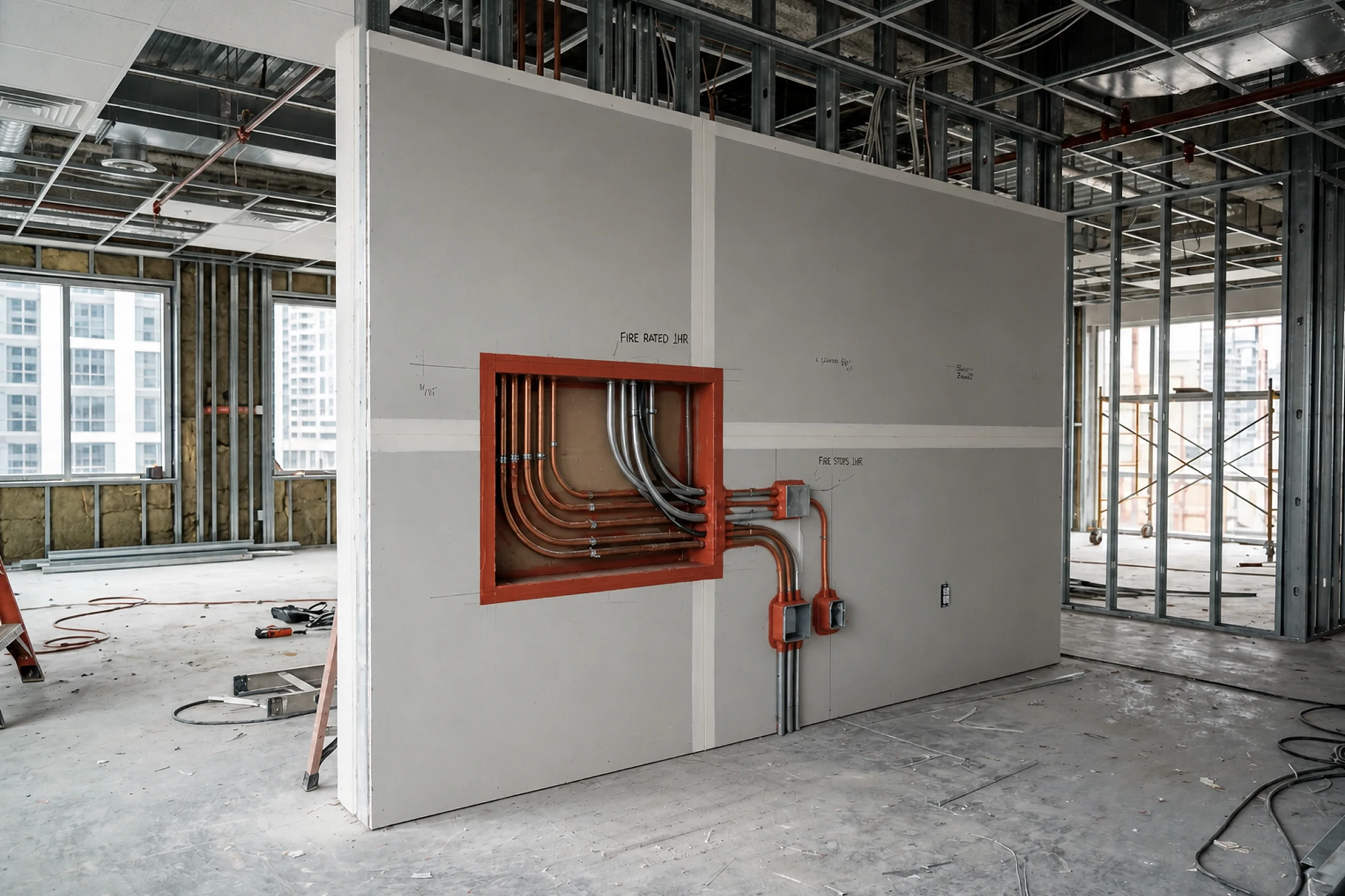
The core requirement: wherever a pipe, duct, conduit, cable tray, or other penetrant passes through a fire separation — a wall or floor assembly with a required fire-resistance rating — the penetration must be firestopped with a listed system that maintains the rating of the assembly.
Here’s what that looks like across common penetration types:
| Penetration Type | Required Firestop |
| Rigid steel pipe through 2-hr wall | ULC-listed sealant + backer rod to 2-hr spec |
| PVC conduit through 1-hr floor assembly | Intumescent sealant + listed wrap or collar |
| Flexible duct sleeve through fire separation | Listed duct wrap or sleeve system |
| Electrical cable bundle through rated wall | Putty, foam block, or sealant per listed system |
| Mechanical penetration with insulation | System must address pipe and insulation separately |
Where Firestopping Is Required
The short answer: any location where a penetrant passes through a fire separation. In a commercial building, that includes:
- Floor-to-floor penetrations — mechanical, plumbing, electrical
- Shaft wall penetrations — piping, conduit, and sleeves into elevator and mechanical shafts
- Suite separation walls and corridor walls in multi-residential and office buildings
- Stairwell and exit enclosure walls
- Fire walls between occupancies
- Party walls in multi-unit commercial buildings
If the wall or floor assembly has a fire-resistance rating and something passes through it, firestopping is required. That’s the working rule.
Why It Gets Missed — and Why That Matters
Firestopping is typically installed near the end of a construction sequence, after mechanical, electrical, and plumbing rough-in is complete. By that point, the schedule is usually compressed. Crews are moving on to the next project. Coordination between trades on who is responsible for which penetrations is often unclear.
The result: penetrations get left open, filled with the wrong material, or partially firestopped and signed off without documentation.
This matters for two reasons. First, the obvious one: in a fire, an unfirestopped penetration can allow flame and smoke to spread to adjacent floors or suites in minutes. The fire-resistance rating of the assembly is meaningless if the penetrations aren’t sealed.
Second, from a project management standpoint: firestopping deficiencies are one of the most common items flagged by building officials during occupancy inspections. Correcting them after the walls are finished and the building is occupied is significantly more expensive and disruptive than doing it right during construction.
What Proper Installation Looks Like
The Right Product for the Right System
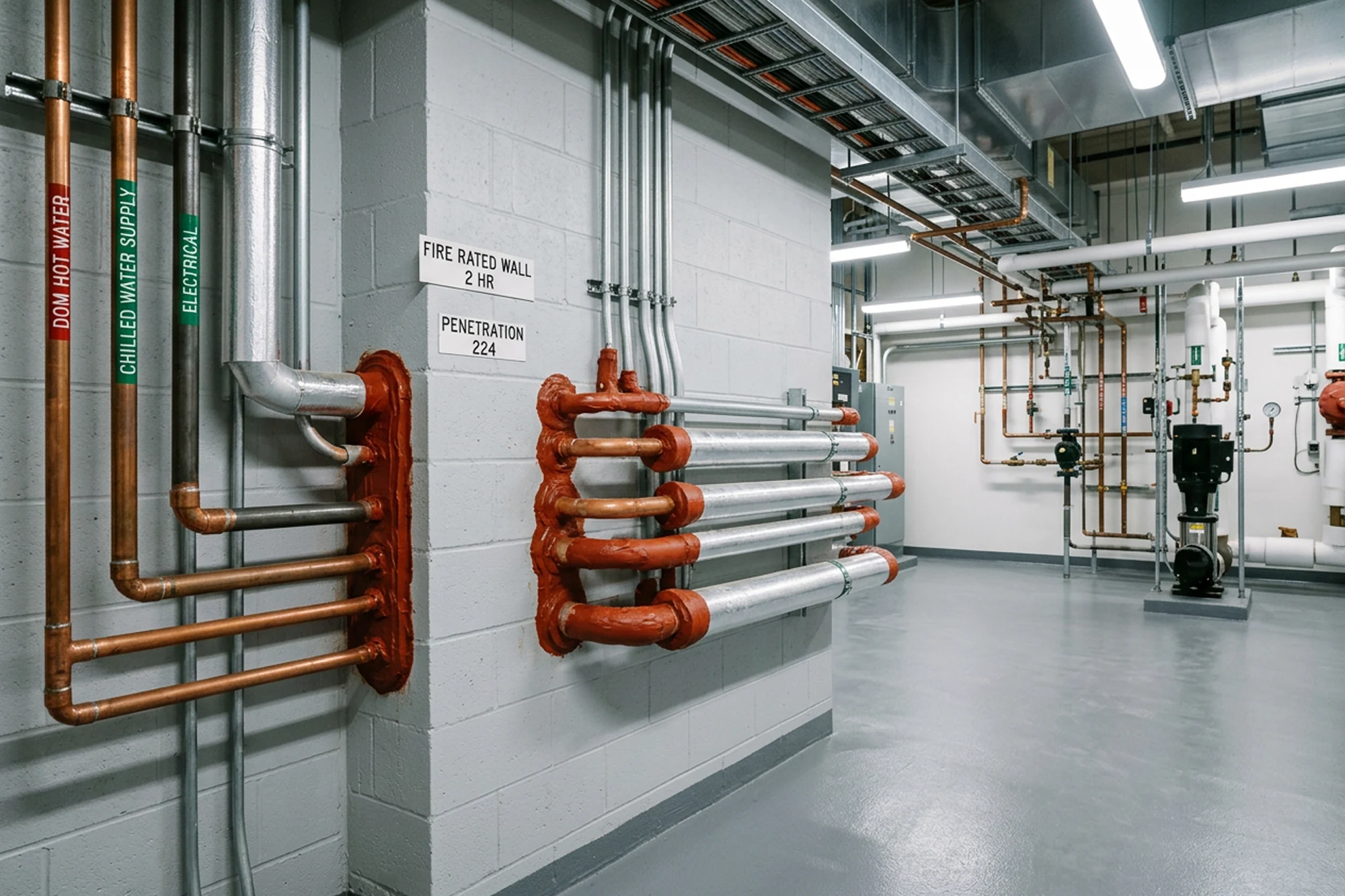
Every penetration gets a ULC-listed system that matches the specific combination of penetrant and substrate. A steel pipe through a concrete slab uses a different system than the same pipe through a Type X drywall assembly. The installer needs to know both the assembly type and the penetrant details before selecting a product.
Correct Annular Space Management
The annular space — the gap between the penetrant and the edge of the hole — has to fall within the listed system’s tolerances. Too large a gap and the listed product may not perform as rated. For larger gaps, a backer rod is required before sealant application. Skipping the backer rod on an oversized gap is one of the most common installation defects we see.
Minimum Sealant Depth
Every listed system specifies a minimum depth of sealant. Applying a thin bead over a large penetration opening doesn’t meet the listing — even if the product itself is correct. Depth matters because the intumescent reaction requires sufficient material mass to seal the opening under fire conditions.
Documentation
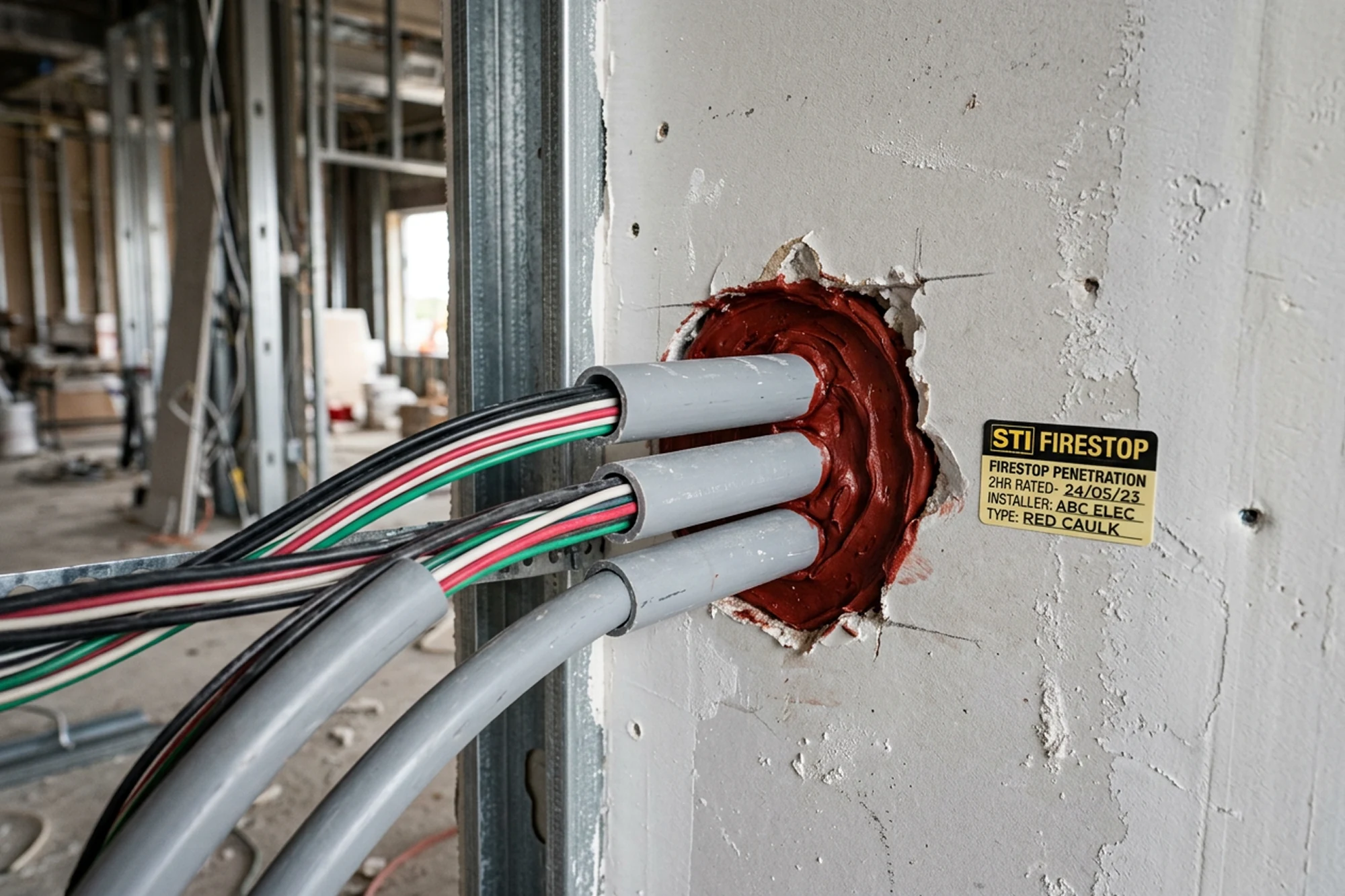
On any project subject to OBC inspection — which is most commercial work — firestopping should be documented before it’s covered. That means photos of each penetration location, the product used, and the ULC system number applied. Some GCs use firestop logs; others accept photos tied to marked-up drawings. Either way, the documentation needs to exist before the inspection walk.
Firestopping and Drywall Coordination — Why It Matters
One coordination issue that comes up repeatedly on commercial jobs: responsibility for firestopping penetrations through drywall assemblies. The mechanical contractor runs the pipe. The electrical contractor runs the conduit. The drywall contractor installs the rated wall. Who installs the firestop?
The answer varies by project and contract structure. But the most efficient arrangement is to have the drywall contractor responsible for firestopping their own rated assemblies — because they know where the fire separations are, they’re already working in the area, and they can sequence firestopping with the wall closeout rather than calling in a fourth party to do it later.
If your project has firestopping work that’s currently unassigned or unclear in your contract structure, sort that out early. Ambiguous responsibility on fire-rated work is exactly how penetrations end up unaddressed at inspection time.
Our Approach on Commercial Projects
At Express Drywall Services, we install fire caulking as part of our commercial drywall scope on projects where our assemblies include fire separations. We work from the tested system specs, use ULC-listed products matched to the specific penetrant and substrate, install to the listed depth and annular space requirements, and provide the documentation general contractors need for occupancy inspection.
We’ve completed commercial drywall and firestopping work across 35+ cities in the GTA — from office and retail builds in North York and Mississauga to healthcare and institutional projects in Barrie and Oshawa. With 20+ years in the commercial drywall trade, we know what inspectors look for. All work is backed by our 1-year warranty.
Get a Free Estimate
If you’re planning a commercial build or tenant improvement project that involves fire-rated drywall assemblies and penetration firestopping, we’re happy to assess the scope and provide a detailed, itemized quote — free, on-site, within 48 hours.
Call Express Drywall Services at (416) 250-6856 or contact us at expressdrywallservices.com. No hidden fees. No delays.